My Text

It is the wisdom of man to sacrifice for his fellow man, in a wise manner

Monday, September 28, 2020

The wise man at River Ganges


A wise man who was visiting River Ganges to take a bath found a group of family members on the banks, shouting in anger at each other. He turned to his disciples smiled and asked. ‘Why do people shout in anger at each other?’

Disciples thought for a while, one of them said, ‘Because we lose our calm, we shout.’ ‘But, why should you shout when the other person is just next to you? You can as well tell him what you have to say in a soft manner.’ asked the man.

Disciples gave some other answers but none satisfied the other disciples.

Finally he explained, "When two people are angry at each other, their hearts distance a lot. To cover that distance, they must shout to be able to hear each other."

"The angrier they are, the stronger they will have to shout to hear each other to cover that great distance."

"What happens when two people fall in love? They don’t shout at each other but talk softly, because their hearts are very close. The distance between them is either non-existent or very small…" The wise man continued, ‘When they love each other even more, what happens? They do not speak, only whisper ‘n they get even closer to each other in their love."

Finally they even need not whisper, they only look at each other and that’s all. That is how close two people are when they love each other.’

He looked at his disciples ‘and said. ‘So when you argue do not let your hearts get distant, Do not say words that distance each other more, Or else there will come a day when the distance is so great that you will not find the path to return.’


The boy and the hammer

 Do you know someone who has a bad temper? Perhaps you have a bad temper that you wish you didn't have. Can you imagine the damage such a temper can do to you and others? 

There once was a little boy who had a very bad temper. One day, bothered by his fits of temper, his father decided to hand him a bag of nails and said that every time the boy lost his temper, he had to hammer a nail into the back fence.
On the first day, the boy had driven 37 nails into that fence.
The boy gradually began to control his temper over the next few weeks, and the number of nails he was hammering into the fence slowly dwindled down. He discovered it was easier to control his temper than to hammer those nails into the fence.
Finally, the day came when the boy didn’t lose his temper at all. He proudly told his father the news and his accomplishment so the father suggested that the boy should now pull out a nail every day he kept his temper under control.
The days passed and the young boy was finally able to tell his father that all the nails were gone. The father took his son by the hand and led him to the fence.

“You have done well, my son, but look at the holes in the fence. The fence will never be the same. When you say things in anger, they leave a scar just like this one. You can put a knife in a man and draw it out. It won’t matter how many times you say I’m sorry, the wound is still there. Son, a verbal wound is as bad as a physica
l one or maybe worse”


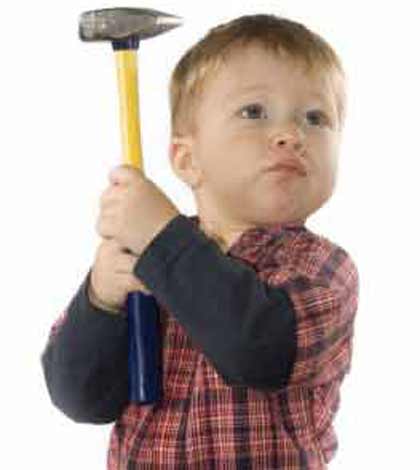
kid showing bad temper with a hammer in hand

Moral of the story: 
Wasn’t that a beautiful story with a valuable lesson? Isn’t it a reminder most us need from time to time?
Everyone gets angry sometime or the other and some of us even have a bad temper, and that’s alright. But remember, once the scars are formed, they take a long time to heal.
Control your anger, and don’t say things to people in the heat of the moment, that you may later regret. Some things in life, you are unable to take back.

The two friends and the Bear

 Vijay and Raju were friends. One day while on holiday, exploring a forest they knew that anything dangerous can happen to them at any time in there. So they promised each other that they would remain united in any case of danger. 

Suddenly, they saw a large bear approaching them.
Naturally, they were both frightened, so Raju, who knew how to climb trees, climbed one quickly. He didn’t spare a thought for his friend who had no idea how to climb.

Related image
Vijay thought for a moment. He had heard that animals don’t attack dead bodies, so he fell to the ground and held his breath. The bear sniffed him, it smelt in his ears, thought he was dead, and went on its way slowly because the bears do not touch the dead creatures.

Moral Stories


Raju, after he had climbed down from the tree asked Vijay, “What did the bear whisper in your ears?”
Vijay replied, “The bear advised me not to believe a false friend and to keep away from you.”

Moral of the story: A friend in need is a friend indeed. A true Friend is the one who always supports and stands by you in any situation.

The Wooden Bowl


A frail old man went to live with his son, daughter-in-law, and four-year-old grandson. The old man’s hands trembled, his eyesight was blurred, and his step faltered. The family ate together at the table.  But the elderly grandfather’s shaky hands and failing sight made eating difficult. Peas rolled off his spoon onto the floor. When he grasped the glass, milk spilled on the tablecloth.
The son and daughter-in-law became irritated with the mess. “We must do something about father,” said the son. “I’ve had enough of his spilled milk, noisy eating, and food on the floor.”  So the husband and wife set a small table in the corner. There, Grandfather ate alone while the rest of the family enjoyed dinner. Since Grandfather had broken a dish or two, his food was served in a wooden bowl!  When the family glanced in Grandfather’s direction, sometimes he had a tear in his eye as he sat alone. Still, the only words the couple had for him were sharp admonitions when he dropped a fork or spilled food.
The four-year-old watched it all in silence.
One evening before supper, the father noticed his son playing with wood scraps on the floor. He asked the child sweetly, “What are you making?”  Just as sweetly, the boy responded, “Oh, I am making a little bowl for you and Mama to eat your food in when I grow up.” The four-year-old smiled and went back to work.
The words so struck the parents so that they were speechless. Then tears started to stream down their cheeks. Though no word was spoken, both knew what must be done.
That evening the husband took Grandfather’s hand and gently led him back to the family table. For the remainder of his day, he ate every meal with the family. And for some reason, neither husband nor wife seemed to care any longer when a fork was dropped, milk spilled, or the tablecloth soiled.
Moral: You reap what you sow. Regardless of your relationship with your parents, you’ll miss them when they’re gone from your life. Always Respect, Care for and Love them. 


Socrates- What is it like to live here

 One afternoon, Socrates was standing outside the gates of Athens when he noticed a traveller who had been staring at him for a long time.

Socrates asked the man why he had come to Athens.
“I am thinking of moving to Athens”, the man said.
“What is it like to live here?” He added.

Socrates looked at him.
“First, would you tell me what it
was like in your home city?”
The man replied: “Oh, it was
awful. Everyone stabs you in the
back and wants to steal money
from you”

Frowning, Socrates told him:
“Well, you will find the same thing here. I suggest you go
somewhere else”


Socrates was standing there a few hours more when another man approached him. This man too had just arrived in Athens and was considering moving to the city. He also asked Socrates, “Can you tell me what it is like to live here?”
Socrates asked, “First, would you tell me what it was like to live there where you come from?”
“Where I come from, all the people work together and help each other”, said the man,
“Kindness is everywhere and you are never treated with anything but complete respect.” He added.


“Well”, replied Socrates, “You will find the same thing here. Welcome to Athens”.


As we can see Socrates had two different answers, even when he was talking about the same city The question is why? Comment on the points you consider important and share it.


The shark and the bait fish

Have you ever wondered what is stopping you from doing something that you truly want or getting something that you have always wanted to have? What is holding you back from making a move and starting to make your way to your goals? How many excuses do you still have to tell yourself just so you could feel better about not taking that big leap?


During a research experiment a marine biologist placed a shark into a large holding tank and then released several small bait fish into the tank.
As you would expect, the shark quickly swam around the tank, attacked and ate the smaller fish.
The marine biologist then inserted a strong piece of clear fiberglass into the tank, creating two separate partitions. She then put the shark on one side of the fiberglass and a new set of bait fish on the other.
Again, the shark quickly attacked. This time, however, the shark slammed into the fiberglass divider and bounced off.  Undeterred, the shark kept repeating this behavior every few minutes to no avail.  Meanwhile, the bait fish swam around unharmed in the second partition. Eventually, about an hour into the experiment, the shark gave up.
This experiment was repeated several dozen times over the next few weeks.  Each time, the shark got less aggressive and made fewer attempts to attack the bait fish, until eventually the shark got tired of hitting the fiberglass divider and simply stopped attacking altogether.
The marine biologist then removed the fiberglass divider, but the shark didn’t attack.  The shark was trained to believe a barrier existed between it and the bait fish, so the bait fish swam wherever they wished, free from harm.
The moral:  Many of us, after experiencing setbacks and failures, emotionally give up and stop trying. Like the shark in the story, we believe that because we were unsuccessful in the past, we will always be unsuccessful. In other words, we continue to see a barrier in our heads, even when no ‘real’ barrier exists between where we are and where we want to go. 

In a nutshell, after we experience obstacles, setbacks and failures, we tend to feel discouraged, dejected and disillusioned. We also tend to internalize and personalise our failures. That is to say, rather than thinking that we failed at something, we tend to think that we are the failures. In other words, rather than being events in our life, our failures become our identities. We let these failures  emotionally wreck us when the only key is to just keep on brushing off the dirt and getting back up from the ground.

Image result for the shark and the bait fish

The Gazelle and The Lion

 No matter the economy of the jungle, the lion will never eat grass. -


Every morning in Africa, a gazelle wakes up, it knows it must outrun the fastest lion or it will be killed. It knows it must run faster than the slowest gazelle, or it will starve. It doesn't matter whether you're the lion or a gazelle-when the sun comes up, you'd better be running.
You better gear up and keep fighting, you are a lion. Stay hungry and keep grinding. #donvicinspiration #DonVicmotivation #DonVic